
Reynolds and colleagues studied both human exercise responses and mouse interventions.
It also matters whether the intervention began with the high-fat diet or after obesity had developed. A reduced intermediate might reflect reduced production, increased consumption or redistribution. The discovery study examined insulin responsiveness in mice — including clamp-based measurements, and reported protection against diet- and age-related insulin resistance.
The preservative inhibits microbial growth (which is what allows a reconstituted), multi-dose vial to be used over roughly four weeks. In a clinical setting this is handled by the compounding pharmacy or trained staff; the walkthrough below explains the process for education and is not an instruction to self-compound gray-market vials. The protocols below are extrapolated from animal studies and refined through physician-supervised compounded use. It is a reasonable hypothesis (not an established effect in people), and human trials looking at obesity, glucose control and aging markers are still early. In the foundational 2015 work — MOTS-c enhanced insulin sensitivity, promoted glucose uptake in muscle, and protected mice against high-fat-diet-induced obesity and insulin resistance. Most therapeutic peptides are based on sequences from nuclear DNA or outside sources.
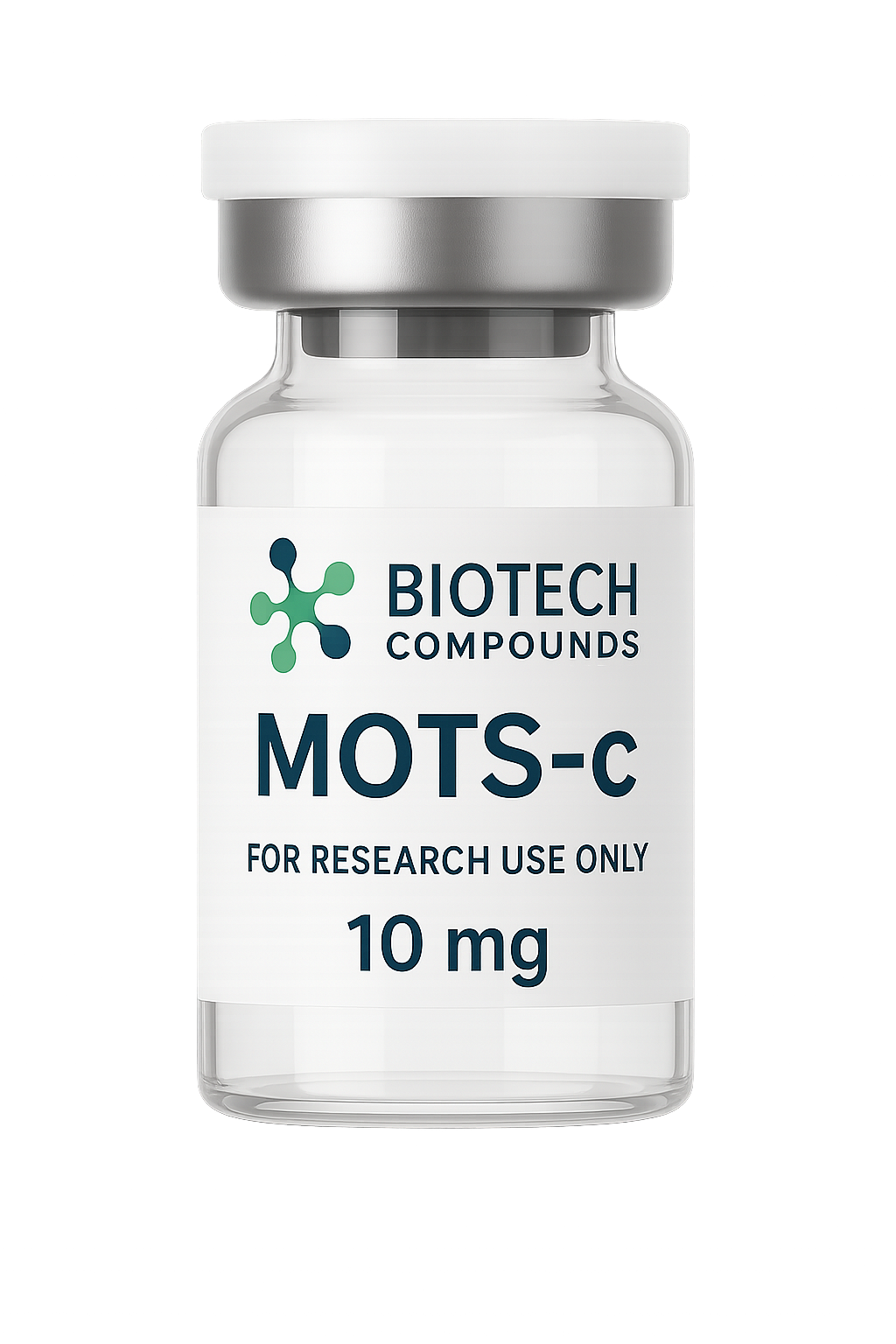
Prefilled using a common vial size for this peptide. Beautiful mechanism — zero administered human data. Two parallel grades per outcome, clinical RCT depth and real-world community adoption. Match the lot number on the vial to its certificate. MOTS-C vial sizes, prices and lots at LDAminosSizeListWith our codePer mgAvailability10 mg$48.99$29.39$2.94In stock40 mg$126.99$76.19$1.90In stock
What Animal Studies Show About MOTS-c
Though studied in preclinical models and early human investigations (MOTS‑C remains classified as a Category 2 peptide in the United States), meaning it is not currently available for pharmacy compounding. Compounded medications are prepared by licensed pharmacies for individual patients and are not FDA-approved. Starting a free online health profile is the first step, and no referral is required to be evaluated. Medications like compounded semaglutide and tirzepatide have extensive published clinical trial data on weight and metabolic outcomes, while MOTS-c research is still mostly limited to animal studies and small human investigations. However — large scale human clinical trials proving specific metabolic health benefits from MOTS-c injections do not yet exist, so claims of guaranteed results are not currently supported. When you are ready, you can start a consultation through the intake form and discuss your metabolic health goals directly with a licensed provider who can walk you through what the evidence does and does not support.
In the original 2015 study, MOTS-c prevented diet-induced obesity and insulin resistance in mice , reference 1,. Levels fall with age and in metabolic dysfunction, which is why it is studied as a kind of mitochondrial hormone the body gradually loses. Animal studies suggest good tolerability, but human data is limited.

Thus — the neglect of the other half of our genome may hold lost opportunities for the identification of novel therapeutic and diagnostic targets for a wide range of diseases. Mitokines or MDPs 32,86 (as described above), provide a paradigm-shifting concept of mitochondrial-derived endocrine factors that may regulate of aging and provide novel therapeutic and diagnostic targets for age-related diseases. Further, based on its fundamental role in regulating metabolic homeostasis, with specific effects on skeletal muscle and glucose metabolism, MOTS-c is also implicated in other areas of study, including exercise and longevity.
Adding 2 mL to a 10 mg vial gives 5 mg/mL, so a 5 mg dose equals 1.0 mL (100 units on a U-100 insulin syringe). Add bacteriostatic water down the inside wall of the vial and swirl gently — never shake. Treating a research-labeled vial as a medication is exactly the behavior this guide advises against. The U.S. Anti-Doping Agency has issued an athlete advisory confirming this and noting that, because MOTS-c has no approved therapeutic use, it is not eligible for a Therapeutic Use Exemption. MOTS-c is not a dramatic, felt-instantly compound for most people.
A non-specialist walk-through of where MOTS-c comes from, how it actually signals at the molecular level, what its metabolic effects look like in animal and early human data, and where the certainty stops. It’s not a direct weight-loss peptide like GLP-1 agonists, but supports metabolic health. MOTS-c activates AMPK, a cellular energy sensor that improves insulin sensitivity by approximately 30% in animal studies. Improves insulin sensitivity by ~30% in animal studies through AMPK activation. MOTS-c, as a small molecular active peptide, has been reported to have potential applications in aging, insulin resistance, cardiovascular disease and inflammation , Figure 1 ,.
MOTS-c peptide provides researchers with a powerful tool to study mitochondrial function (metabolic regulation), and systemic energy balance. Currently, MOTS-c is primarily studied in preclinical models; human applications remain experimental. MOTS-c is a mitochondria-derived peptide that regulates energy metabolism (mitochondrial function), and metabolic health. These limitations emphasize the need for continued research to fully understand MOTS-c’s therapeutic and metabolic potential Its unique ability to influence mitochondrial function has made it an important subject of study in obesity, insulin resistance, and age-related metabolic decline.
Those pathways can relate to body composition (but pathway evidence is not the same as proving belly-fat loss in people 1), 2. A careful review should include blood sugar risk (medication interactions), pregnancy status, cancer history, immune conditions, sport-testing rules, and product quality 2, 4, 7. That family is being studied because mitochondrial function changes with age (metabolic stress), and chronic disease risk 6. MOTS-c has a real link to exercise biology in the research literature. Safety questions include blood sugar shifts, injection reactions, uncertain long-term effects, and product-quality risks 2, 7.
Key facts

MOTS-c is being studied for metabolic pathways related to insulin sensitivity and fat metabolism, but it is not proven to reduce belly fat in people. A patient-specific prescription, legal sourcing, sterile preparation, and clinician follow-up are different from buying a vial online without oversight 7. MOTS-c may help researchers understand aging pathways (but it has not been shown to extend lifespan), slow aging, or improve healthspan in people 2, 6. MOTS-C is also being studied for its ability to manage metabolic disorders and protect against obesity and insulin resistance. Position it as a mitochondrial support peptide for patients with metabolic syndrome, insulin resistance, or significant fatigue. TakeawayMOTS‑C is a promising mitochondrial derived peptide studied for metabolic and stress‑response effects.
Readers interested in this broader mitochondrial-signaling research landscape may find it useful to review Royal Peptide Labs’ dedicated overview of mitochondrial peptides and cellular energy research, which situates MOTS-c alongside other compounds studied for their role in mitochondrial function. Because MOTS-c shares conceptual territory with other metabolic and longevity-adjacent research peptides, it is frequently studied in comparative or combination protocols. MOTS-c has attracted research interest for what is sometimes described as an “exercise-mimetic” signaling profile — a framing based on research observing that MOTS-c-related signaling activity appears to change in skeletal muscle and circulating compartments in response to physical activity in study models.
Peptide science researchers with 5+ years in US-based peptide manufacturing, independent HPLC/mass spectrometry testing, and research education. Exercise induced 11.9-fold increase in skeletal muscle MOTS-c in humans. Chronic training increased MOTS-c protein expression 1.5-5-fold in muscle tissue, demonstrating both acute and chronic exercise-enhancing effects. Human study found significantly lower serum MOTS-c levels in GDM patients versus controls.
Although it seems advantageous — attributing my results specifically to MOTS-C is challenging due to my extensive training with TRT and CJC1295/ipamorelin as well. It should be noted that this user experienced minimal personal effects — and the “typical protocol” they mention is more of a community standard rather than a rigorously studied regimen. In my experience, this treatment serves as an excellent complement for patients experiencing any form of mitochondrial dysfunction. Given the scarcity of human research on MOTS-C — many individuals turn to user testimonials for insights. To understand what users reported noticing throughout a cycle and the realism of those assertions, refer to our guide concerning MOTS-C before and after. Since animal dosages are calculated based on body weight in kilograms and do not translate directly to humans, the figures below are derived from user testimonials rather than formal studies.